
Java Roadmap
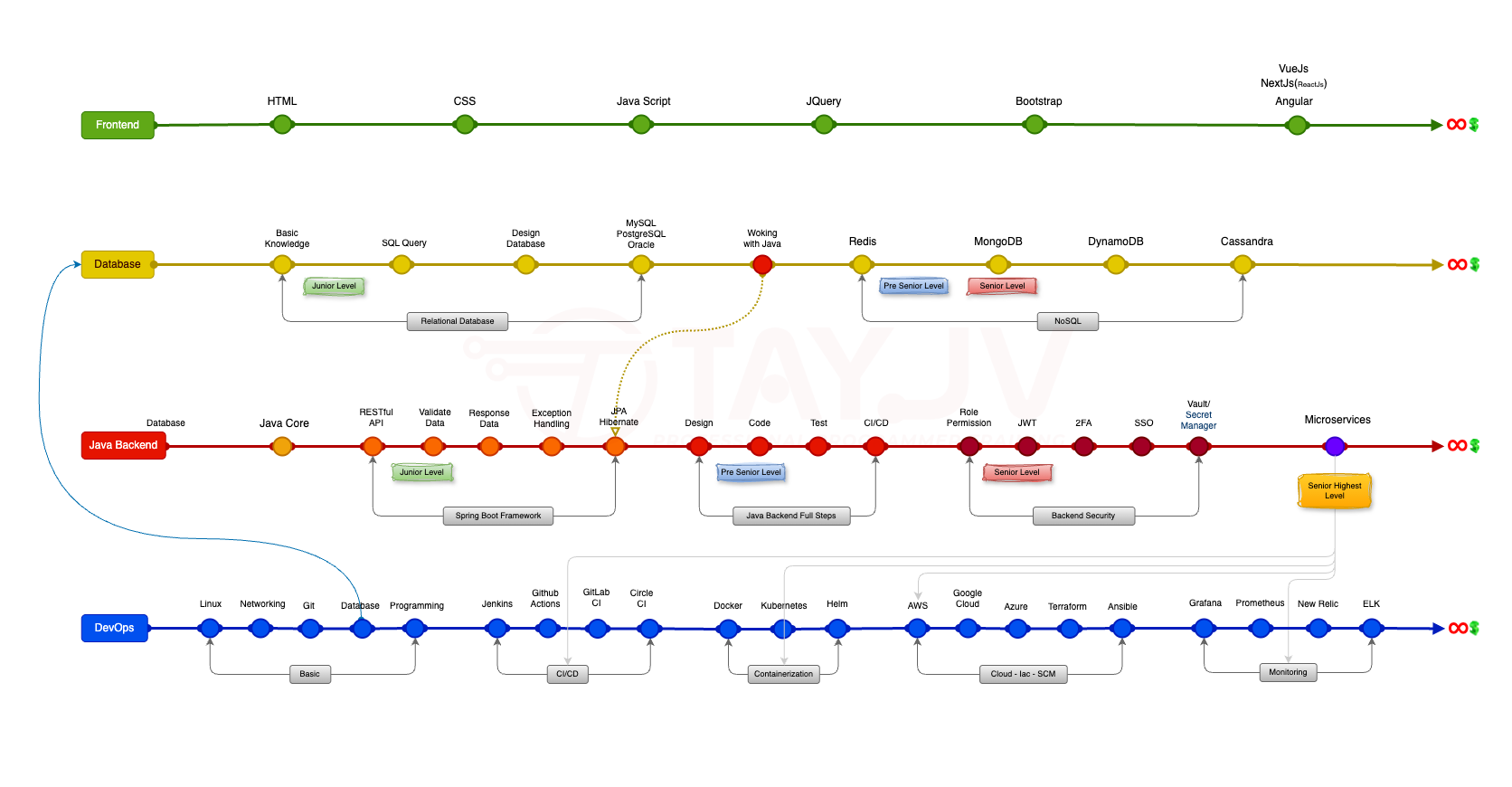
The Java Backend Developer roadmap follows a main path: Computer Science → Java Core → Build Tools & Git → Database → Backend Development → Spring Ecosystem → Security → Testing → Architecture → DevOps. Each step builds the foundation for the next, designed for developers building a Java backend career.
Computer Science
Before writing backend code you need solid computer science foundations: how the OS manages processes and memory, how data travels over the network (TCP/IP, HTTP, DNS), plus data structures and algorithms. This is what lets you understand what runs "under the hood", write efficient code and pass algorithm interviews. Don't skip it even though it doesn't directly ship a product.
Java Core
Master the Java language before touching any framework. Focus on OOP (encapsulation, inheritance, polymorphism), Collections, exception handling, the Stream API, concurrency, and how the JVM manages memory and garbage collection. With this nailed down, Spring will make sense as "why" rather than just "follow along".
Build Tools & Git
Every real project needs build tooling and version control from day one. Learn dependency management and packaging with Maven or Gradle, and work with Git using a team workflow (branching, merging, pull requests, conflict resolution). These skills are used throughout your whole career, so get fluent early.
Database
Backend is all about data, so deep database knowledge is a must. Learn SQL thoroughly, database design (ERD, normalization, indexing), transactions and isolation levels, query optimization and connection pooling. Beyond RDBMS (MySQL, PostgreSQL), get familiar with caching (Redis) and NoSQL (MongoDB) to pick the right tool for each problem.
Backend Development
This is where everything comes together into a real API. Understand how HTTP and REST work and the JSON data format, then build the core features: validation, logging, centralized error handling, pagination, caching, file upload and email. The goal is clean, maintainable, standards-compliant APIs before adding a framework.
Spring Ecosystem
Spring is the dominant Java backend ecosystem. Learn Spring Boot for fast bootstrapping, Spring MVC for the web layer, Spring Data JPA for data access, Spring Security for auth, and Spring Cloud for distributed systems. Because you already know Java Core and REST, you'll understand what Spring does under the hood instead of treating it as a black box.
Security
Security must be designed in from the start, not patched on later. Learn authentication and authorization: JWT, OAuth2, SSO, two-factor authentication (2FA) and role-based access control (RBAC). This complements Spring Security from the previous step — here you learn the concepts, while Spring is the implementation.
Testing
Code without tests is hard to trust. Learn to write unit tests with JUnit, mock dependencies with Mockito, and write integration tests that exercise whole flows. Testing early lets you refactor safely, catch bugs before production, and is a key expectation in professional environments.
Architecture
As systems grow, architecture determines scalability and maintainability. Get comfortable with Monolith, Clean Architecture, DDD and System Design / distributed systems principles before jumping into Microservices. Once split, services communicate via API Gateway, Service Mesh and Message Queue (Kafka, RabbitMQ) — the core of large-scale backends.
DevOps
The final step is shipping to production and operating reliably. Learn to containerize with Docker, orchestrate with Kubernetes, build CI/CD pipelines to automate build & deploy, deploy on Cloud (AWS) and observe the system with Monitoring/Logging. These skills keep your product running reliably at real-world scale.
